Safety: Gordon Drive cannot safely absorb the traffic.
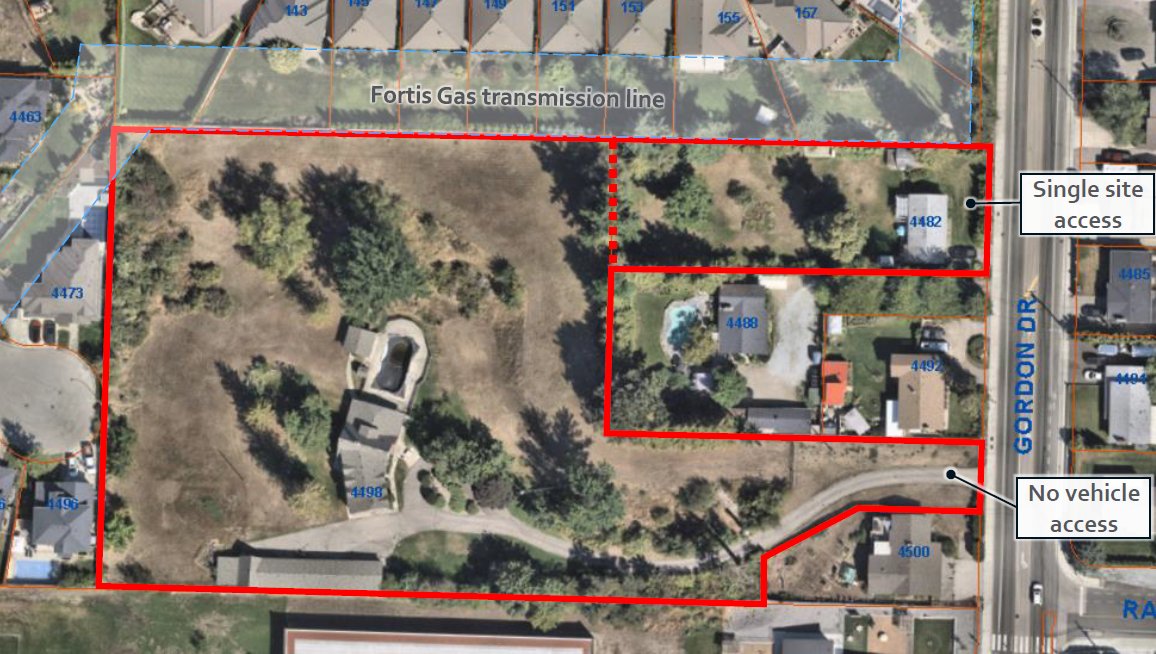
Existing morning peak traffic at this stretch is already operating at “difficult” to “dangerous” merge conditions. An independent time-stamped count on Friday, May 1, 2026 documented 400 vehicles in the 8:45 AM peak interval, with northbound merge opportunities ranked “dangerous” (under 3 seconds between vehicles) at 8:30 AM.
The applicant’s traffic analysis concludes “minimal impact.” That conclusion rests on counts taken March 23–24, 2026 — both inside School District 23’s spring break. Schools were closed; buses were not running. The study captured PM peak only — no AM peak data was collected at all.
The proposed driveway exits onto a sidewalk used daily by children walking to Dorothea Walker Elementary, Bellevue Elementary, Okanagan Mission Secondary, and the YMCA daycare. Drivers exiting left will not have a clear sightline because of the existing hedge and fencing — forcing them forward into the sidewalk to merge.
The neighbouring strata at 4450 Gordon Drive was required to build a 30-metre curb extension for safe egress onto the same arterial road. That same standard has not been applied to this proposal — despite a larger development funnelling onto a single access at the same stretch of Gordon Drive.
Sensitive transition: the form doesn’t fit the street.
OCP Policy 7.2.1 requires that larger buildings “transition their height and massing towards adjacent lower-density suburban neighbourhoods.” A single consolidated block of 65 row townhouses — three storeys plus rooftop patios, four levels in all, served by one access point — does not transition toward its neighbours. It abuts them.
The rooftop decks would look directly into the Okanagan Mission Secondary school grounds and over neighbouring back yards. We are not opposed to development here. We support thoughtful development that steps down toward the homes around it, with a form and scale that belong on this street. That is the standard the OCP itself sets.
The applicant points to two existing MF2 developments — 600 Sherwood Road and Mission Villas — as comparable. Both, in fact, did what this proposal does not: they stepped their height down to match neighbouring rooflines, protected boundary privacy, and kept their main access off the arterial. Held to the standard of the applicant’s own examples, this proposal falls short.
Achieving this density also requires removing nearly every mature tree on the site — including trees with active osprey nests documented by residents. Under section 34 of the BC Wildlife Act, it is an offence to destroy an osprey nest in active use. The application does not address how this conflict will be resolved.
Contribution: the proposal gives nothing back.
Strip away the planning language and the deal is simple: they build, the neighbourhood pays. OCP Policy 7.2.1 calls for a public park component and an affordable or rental housing component in proposals of this scale. This application offers neither — and under the proposed MF2 zoning, the City cannot require them.
So the neighbourhood absorbs every cost of this density — more traffic, a park already at capacity, and the loss of privacy and light for the homes next door — while the project returns no park, no affordable units, and no rental units. All cost, no benefit. A proposal that asks this much of a community should give something back. This one gives nothing.