Where is this?
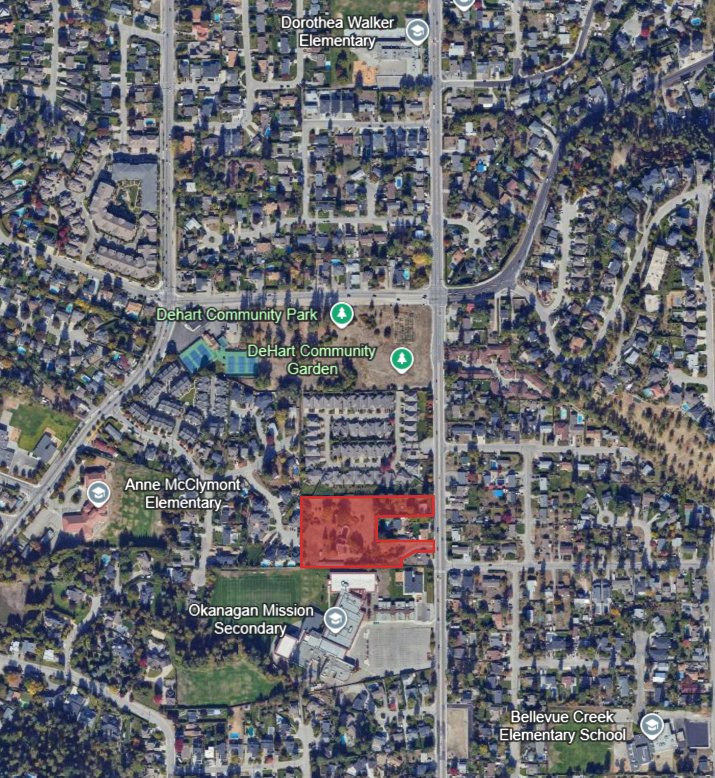
4482 & 4498 Gordon Drive, Lower Mission.
Two adjoining lots on Gordon Drive, immediately beside Okanagan Mission Secondary School and within walking distance of two elementary schools, a daycare, and DeHart Park.
A quick orientation for anyone new to this file: where the site is, what the application would build, how the approval process works, and where to read every document yourself.
Two adjoining lots on Gordon Drive, immediately beside Okanagan Mission Secondary School and within walking distance of two elementary schools, a daycare, and DeHart Park.
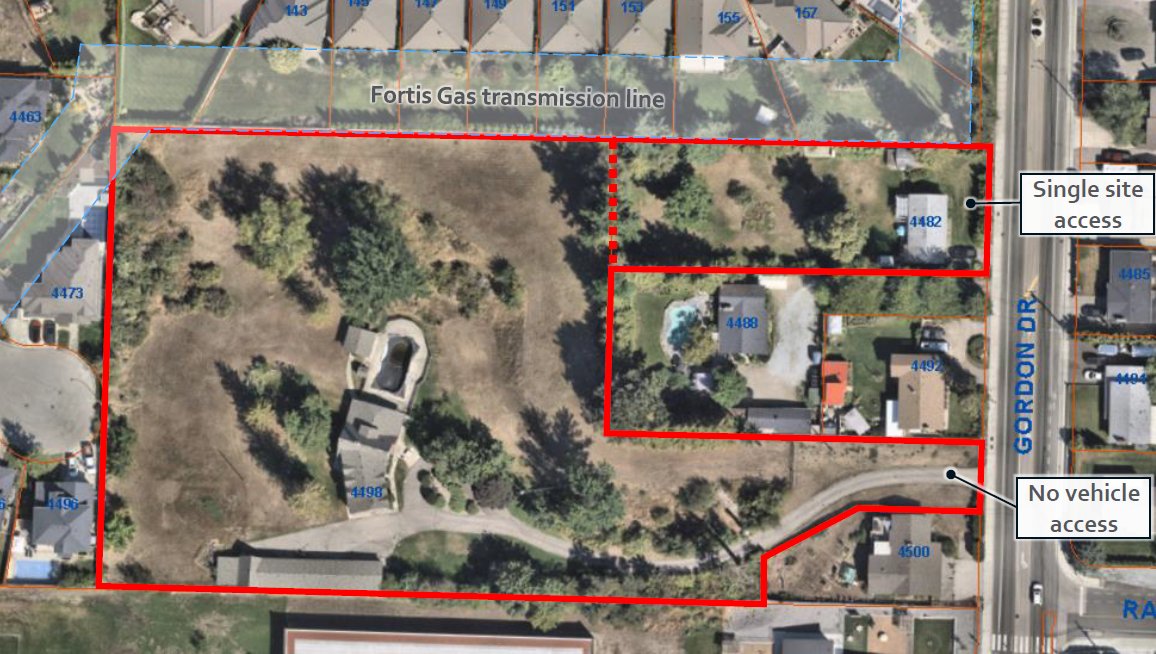
Site: 4482 & 4498 Gordon Drive — two lots, roughly 1.6 hectares (about 4 acres), proposed to be consolidated.
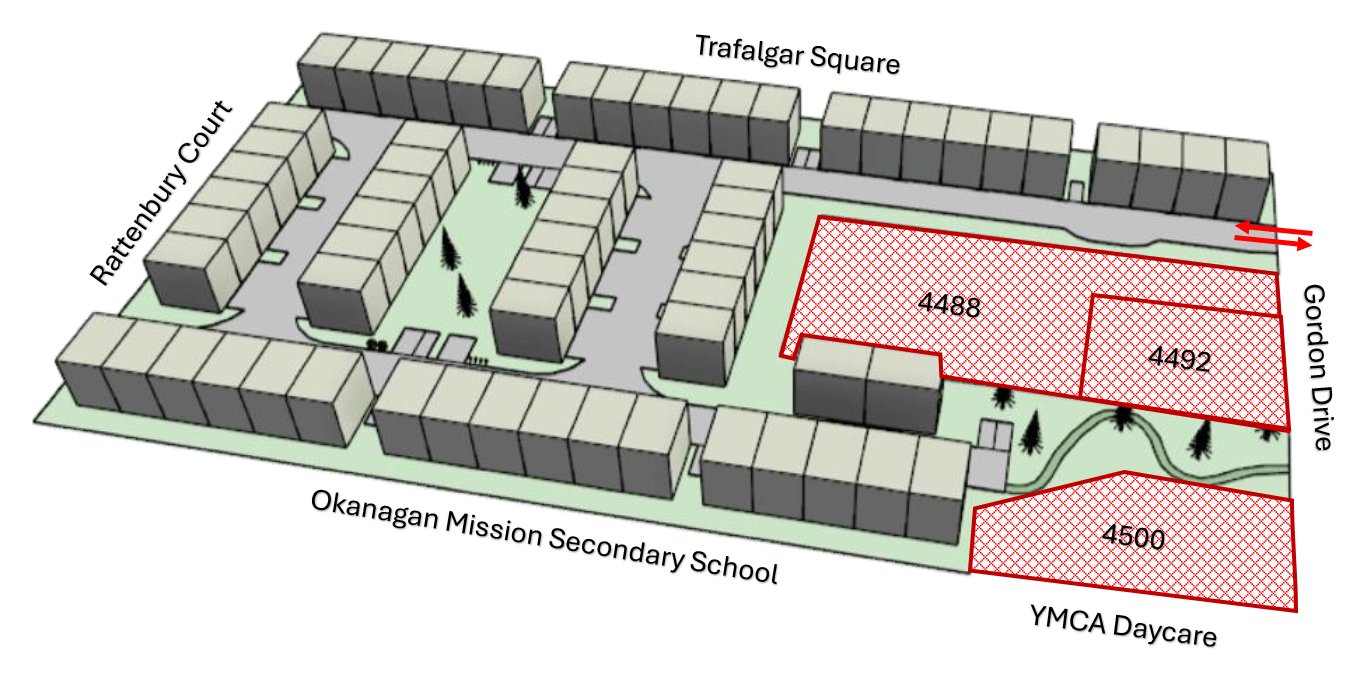
Proposal: 65 row townhouses.
Today: zoned RU1 (Large Lot Housing); designated S-RES (Suburban Residential) in the OCP.
Proposed change: rezone to MF2 (Townhouse Housing); redesignate to S-MU (Suburban Multiple Unit).
Height: three storeys, topped with rooftop patios — four levels in all. The rooftop decks would look directly into the Okanagan Mission Secondary school grounds and over neighbouring back yards.
Access: a single driveway onto Gordon Drive, an arterial road already congested at school drop-off and pick-up.
This application bundles two changes the City must approve together, followed by a later design stage. Because it includes an OCP amendment, a public hearing is required — that hearing is the public’s main opportunity to be heard.
Change the long-range land-use designation from S-RES (Suburban Residential) to S-MU (Suburban Multiple Unit). This is the “big picture” change.
Change the zoning from RU1 (Large Lot Housing) to MF2 (Townhouse Housing). This is what sets how much can be built.
Because the application amends the OCP, a public hearing is mandatory — at an earlier initial-consideration meeting, Council voted to forward it here. Residents can submit written comments and speak for up to 5 minutes. This is the moment that matters most. If Council supports the application after the hearing, it gives the bylaws second and third readings at the same meeting.
Before the bylaws can be adopted, the developer must meet the conditions set in Council’s resolution — engineering and servicing requirements, legal covenants, and any Ministry of Transportation approval. Once those are met, Council can give fourth and final reading and adopt the bylaws. The OCP amendment and rezoning then attach to the land permanently.
Before construction, the developer must obtain a Development Permit — Kelowna’s review of the building’s “form and character,” including its site plan, elevations and landscaping. This permit must comply with the zoning granted above: it cannot reduce the density or change the land use approved at rezoning, or revisit whether the project belongs here, and it allows virtually no public input.
Everything on this site is drawn from public City of Kelowna documents, the applicant’s own materials, or BC statute. Verify any of it. The file number is OCP25-0023 / Z25-0053.
The City’s development-applications map. Search the site to open the file and the submitted materials.
Agendas, staff reports, minutes, and on-demand video — including the May 4, 2026 first reading and the June 23 hearing.
The City’s long-range land-use plan, adopted January 10, 2022.
The adopted bylaw text and consolidated amendments.
The City’s own explanation of the steps, readings, and public hearing.
The Province’s overview of what an OCP is and the legislation behind it.
The materials Council considered at first reading, and the community’s response — all public record, hosted here for easy access.
The planning department’s report and recommendation to Council at first reading.
The applicant’s submission — site plans, drawings, and rationale (LIME Architecture).
The City’s Development Engineering comments on the application — vehicle access, road dedication, and servicing requirements on Gordon Drive.
The City’s official minutes — the motions and first-reading votes on the Gordon Drive bylaws (agenda items 3.3 and 3.4).
The City’s official recording of the council meeting. Gordon Drive is agenda items 3.3 and 3.4.